
What Are the Structural Causes of Colombia’s Problems?
Institutions, Incentives, and the Barriers to Building at Scale

Colombia faces a set of persistent challenges.
The country continues to exhibit significant infrastructure gaps in roads, logistics, ports, and urban transport, limiting connectivity and competitiveness.
It also faces a large quantitative and qualitative housing deficit, particularly in fast-growing urban areas.
Although access to education has expanded substantially, learning outcomes remain weak, and Colombia struggles to retain high-skilled talent capable of driving innovation and institutional learning.
At the same time, roughly half of the workforce operates in the informal economy, constraining productivity, firm growth, and state capacity. Long-term productivity growth has been modest, reflecting weak diffusion of innovation and limited scaling of high-performing firms.
Finally, Colombia faces growing tension between environmental protection objectives and the need to expand infrastructure, energy generation, and other large-scale projects.
Understanding why these problems persist requires looking beyond surface-level symptoms and examining the institutional and incentive structures that shape outcomes.
This article focuses on some of the structural causes behind these problems. Rather than treating each issue in isolation, it examines the institutional, regulatory, and incentive-related factors that shape how Colombia builds, allocates resources, and translates effort into outcomes. The goal is to understand why well-known challenges persist and why progress has often been slower and more uneven than the country’s potential would suggest.
A central structural cause behind many of Colombia’s constraints is limited state capacity to plan, coordinate, and execute complex projects at scale. While the country has formal institutions, public investment often struggles with fragmented responsibilities, long timelines, and weak technical continuity across administrations. International diagnostics from the World Bank and OECD consistently show that implementation gaps (not the absence of policy frameworks) are a binding constraint. This weak builder capacity affects infrastructure delivery, housing construction, energy expansion, and even education systems that require sustained execution over time.
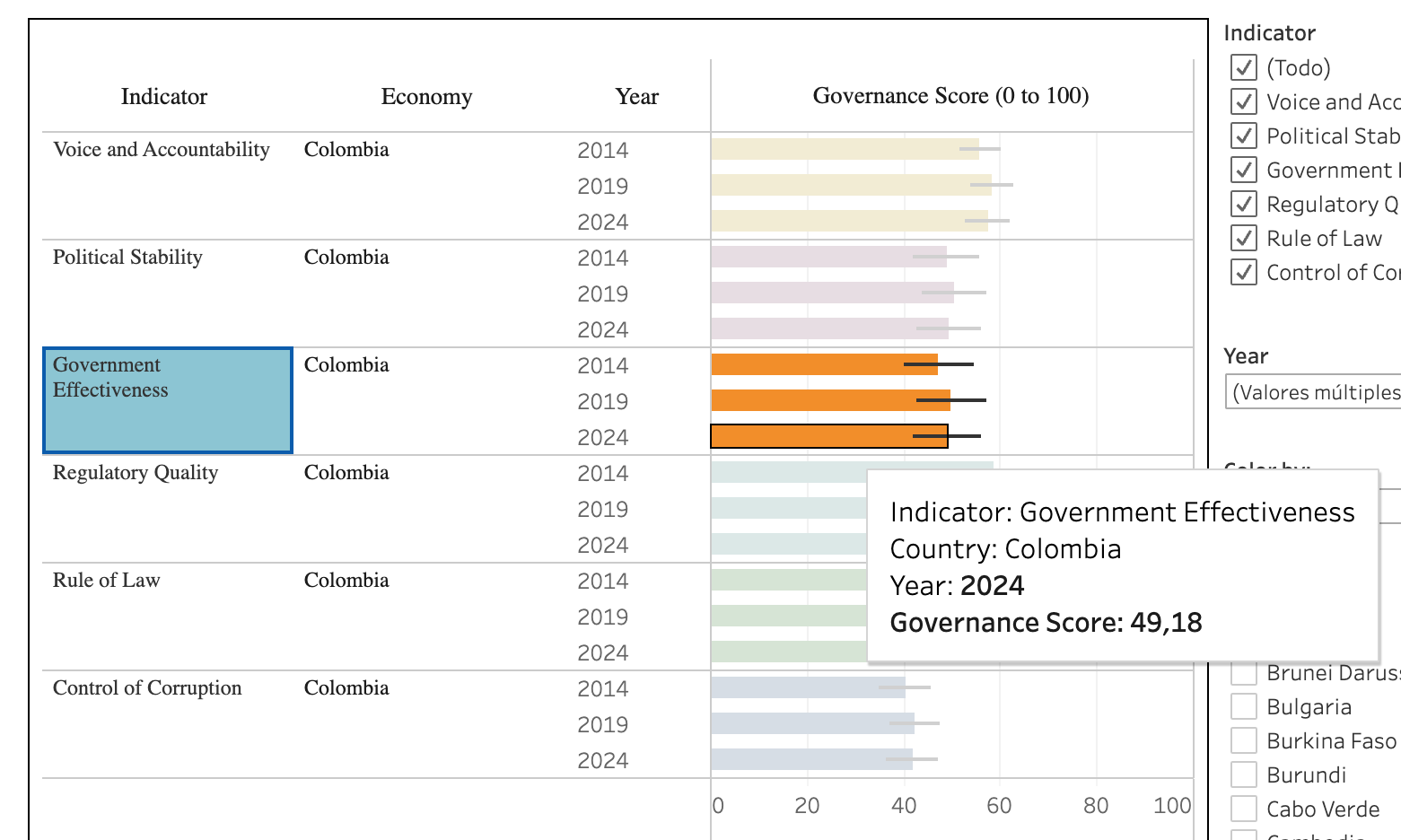
Source: https://www.worldbank.org/en/publication/worldwide-governance-indicators/interactive-data-access
Over time, Colombia has accumulated layers of regulation across sectors, often introduced to address legitimate concerns but rarely revisited or evaluated. OECD regulatory reviews highlight a strong emphasis on ex-ante controls and procedural compliance, with limited use of ex-post evaluation or outcome-based review. The cumulative effect is slower decision-making, legal uncertainty, and high fixed costs for building and scaling projects. This regulatory drag contributes to underbuilding in infrastructure and housing, discourages formalization, and delays energy and environmental projects.
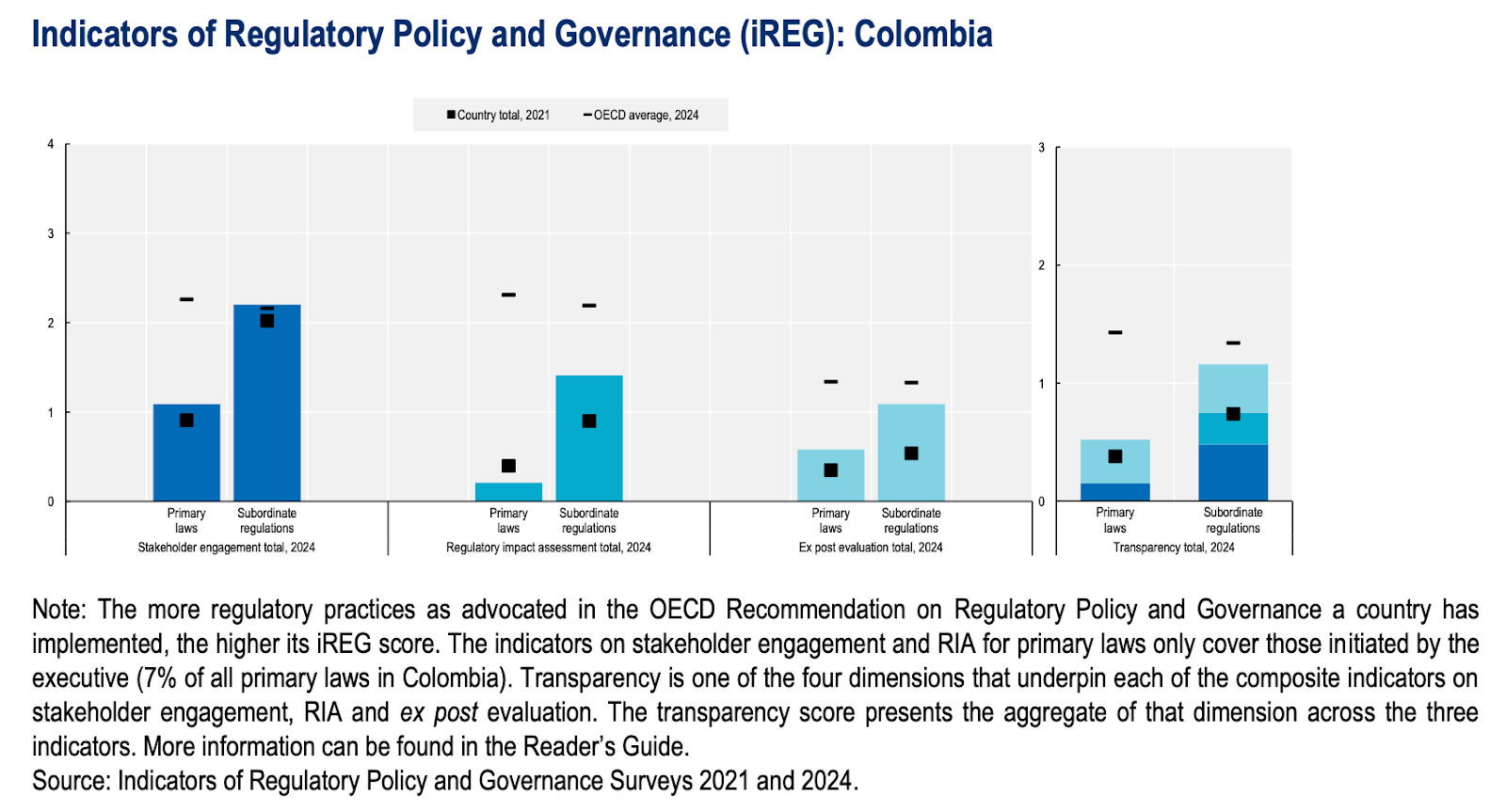
Source: https://www.oecd.org/en/publications/2025/04/oecd-regulatory-policy-outlook-2025_a754bf4c.html
Informality in Colombia is not a temporary distortion but a stable equilibrium shaped by institutional design. DANE and OECD data show that high regulatory costs, complex tax systems, and rigid labor rules make formality unattractive for many firms and workers. Informality allows economic survival but prevents scale, productivity growth, and learning. This equilibrium weakens the tax base, limits social protection, and constrains state capacity, reinforcing many of the country’s other structural problems.
Colombia’s economy struggles to reallocate labor and capital toward their most productive uses. Evidence shows that capital and labor are not systematically directed toward the most productive firms, but instead remain trapped in less efficient ones due to distortive regulations, credit constraints, uneven enforcement, and institutional frictions. As a result, highly productive firms operate below their potential while low-productivity firms survive and even expand, reducing aggregate output.
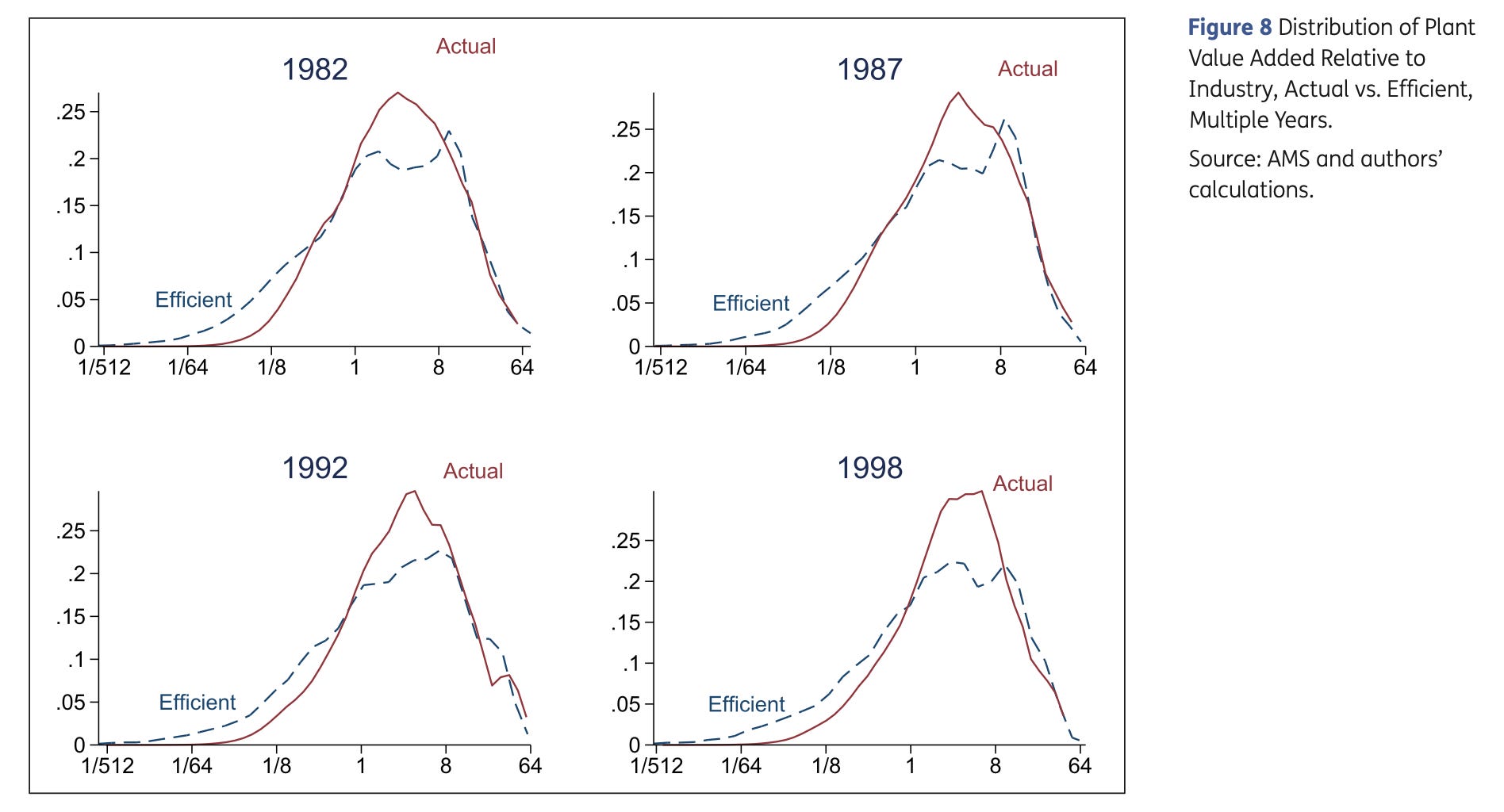
Source: https://economia.lse.ac.uk/articles/10.31389/eco.431
Although Colombia produces skilled professionals, its institutions struggle to offer credible pathways for high-impact work in science, technology, and complex problem-solving. Data from OECD, UNESCO, and the IDB show sustained emigration of highly educated Colombians, driven not only by wages but by stronger research ecosystems and institutional opportunities abroad. Domestically, weak links between universities, industry, and the state limit the productive use of talent. This misallocation affects innovation, education quality, and long-term institutional learning.
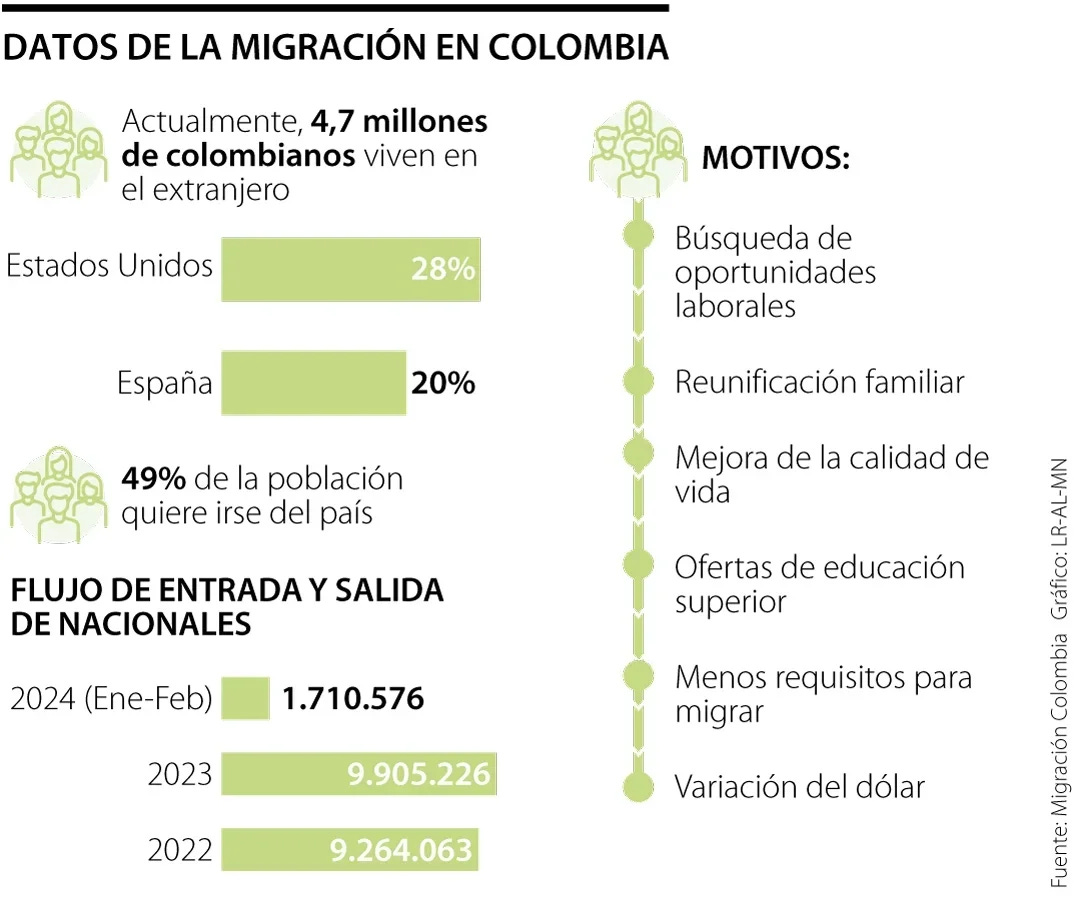
Many of Colombia’s challenges reflect the dominance of short-term political and administrative horizons over long-term national projects. OECD and IDB analyses highlight frequent policy discontinuity, administrative turnover, and limited institutional memory. Large-scale investments in infrastructure, energy systems, and human capital require sustained commitment over decades, yet Colombia’s governance structures often reset priorities every electoral cycle. This short-termism fragments progress and prevents cumulative gains.
Finally, low levels of institutional trust and a widespread skepticism about large-scale improvement weaken Colombia’s capacity to mobilize collective action. Surveys from Latinobarómetro, the World Values Survey, and OECD trust indicators consistently show low confidence in public institutions. While distrust is often justified by past failures, it also raises resistance to reform, increases litigation, and encourages defensive governance. From a Progress Studies lens, this erosion of confidence reduces society’s willingness to build, experiment, and accept trade-offs—making paralysis more likely than progress.
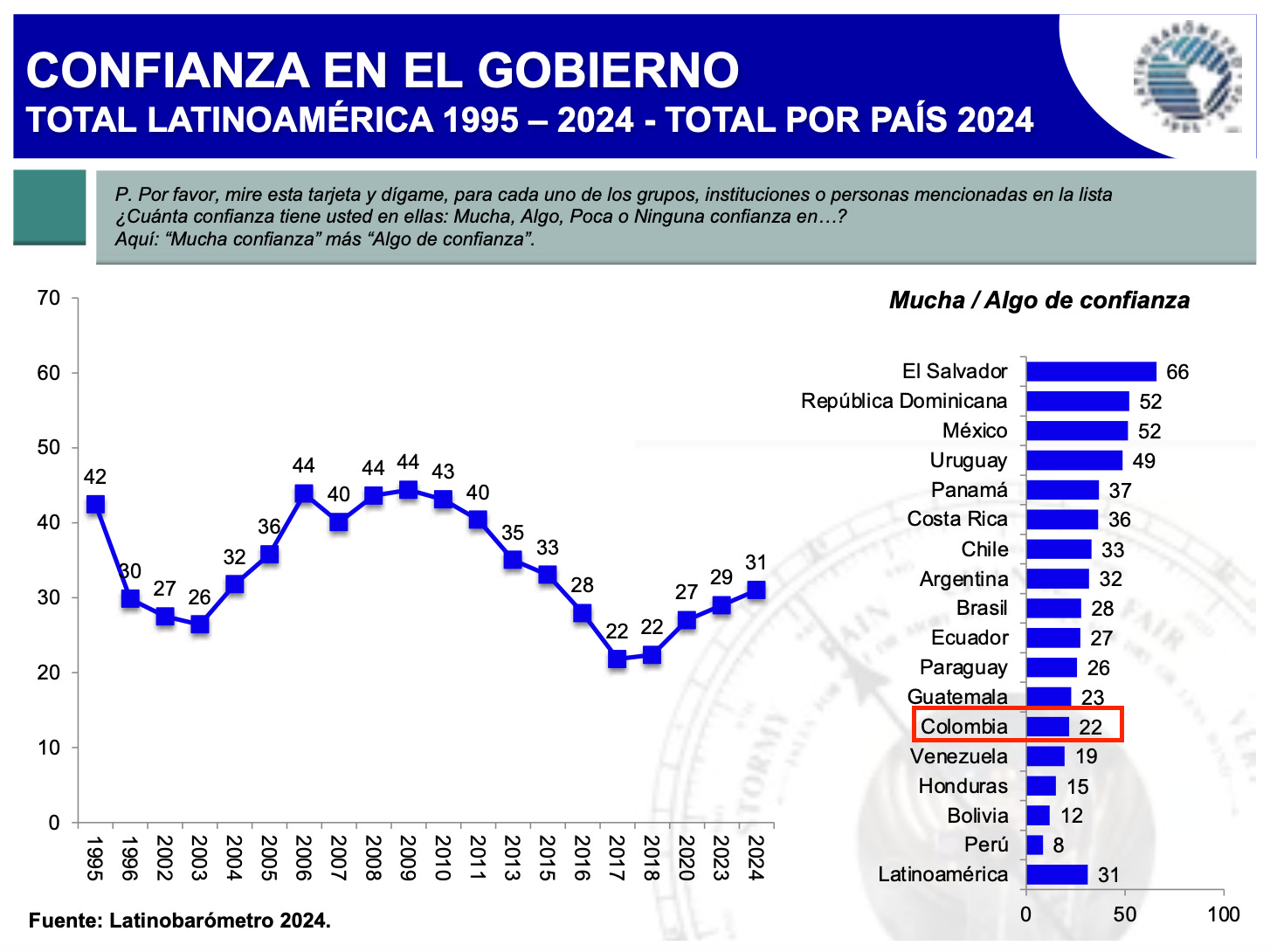
Source: https://www.latinobarometro.org/latinobarometro-2024
Taken together, these structural causes help explain why Colombia’s development challenges appear across so many domains at once. Weak execution capacity, misaligned incentives, misallocation of talent and capital, short-termism, and low institutional trust are not independent failures, they reinforce one another. From a Progress Studies perspective, this suggests that Colombia’s central problem is institutional systems that struggle to let progress compound. Recognizing these constraints is a necessary step toward designing reforms that enable building, scaling, and innovation at the pace required for sustained prosperity.
“weak links between universities, industry, and the state limit the productive use of talent” I wonder - do the weak links really drive low productivity? Thinking out loud: I would guess that low capital investment and relatively small market opportunities might be bigger factors here.
Perhaps related if your point is that the state isn’t deploying capital and providing security guarantees or proper regulation needed for markets to be as effective as they could be